

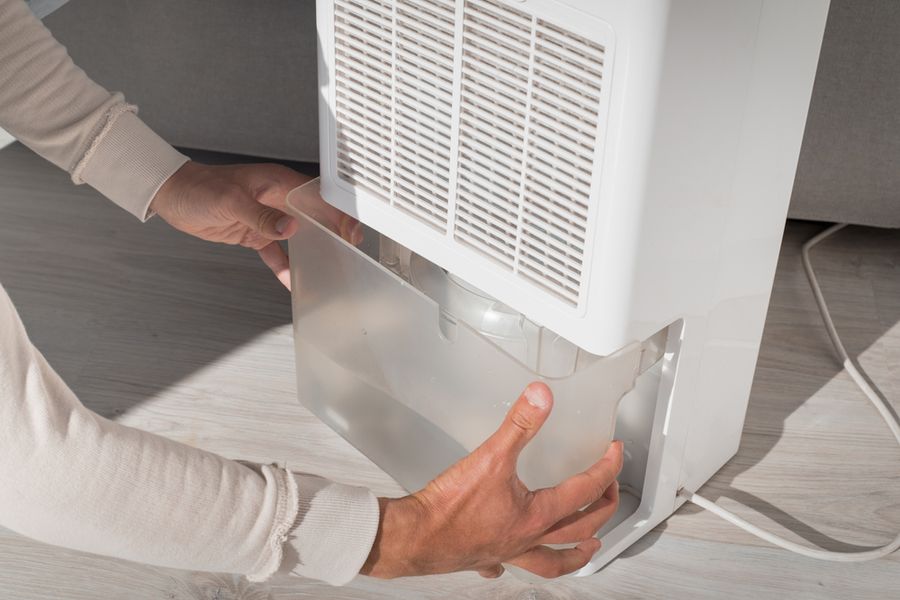
A home dehumidifier reduces excess moisture in your living space to improve comfort and help prevent musty odors, mold growth, and sticky indoor air. For homeowners and residents dealing with humid climates, damp basements, or rooms that never quite stay dry, the right dehumidifier can make a noticeable difference in day-to-day comfort and help protect your home and belongings from moisture-related problems.
How Does a Dehumidifier Work?
A dehumidifier removes moisture by pulling in humid air, cooling it below its dew point so moisture condenses out, then reheating and releasing the drier air back into the room at the desired humidity level. Two main technologies do this differently.
Refrigerant (Compressor) Dehumidifiers
These portable dehumidifiers are most common type and work like a mini air conditioner.
- A fan draws room air across cold refrigerant-filled coils.
- The air cools below its dew point, so water vapor condenses into liquid droplets on the coils.
- The condensed water drips into a collection tank (or drains out via a hose).
- The now-drier air passes over a second set of warm coils (the condenser) that reheats it slightly before it's released back into the room.
- A humidistat monitors indoor humidity and cycles the compressor on/off to maintain the target level.
Desiccant Dehumidifiers
This type works differently: air passes over a moisture-absorbing material (like silica gel) on a rotating wheel. The desiccant soaks up water vapor, then a separate heated air stream dries out the desiccant so it can absorb more, while that moisture-laden air is vented outside or condensed and drained. These don't rely on cooling, so they work well even in cold rooms where compressor units struggle.
Critical Features To Consider
Before you buy one, it helps to understand how dehumidifiers work and which features matter most, including capacity, humidity control, drainage options, noise, energy efficiency, portability, and ease of use, so you can choose a model that fits your space, budget, and moisture level.
Determine the Capacity You Need
The first step when buying a dehumidifier is choosing the right capacity. A dehumidifier's capacity is rated by how many pints of moisture it removes per day, not gallons. Units for smaller spaces can work well in bathrooms or laundry rooms, while areas with heavier moisture problems may need a high capacity model.
As a general guide, a small dehumidifier removes less than 30 pints daily, medium-capacity models remove 30 to 40 pints daily, and large capacity dehumidifiers remove 40 pints or more daily.
To estimate the size you need, consider where the dehumidifier will be placed and how damp the area is when you start. A basement generally requires more moisture removal because it tends to be cooler and naturally damp. Living rooms, bedrooms, and open floor plans may only need mid-range capacity. If your home experiences seasonal humidity, you may want a unit that's flexible enough to run harder in summer and lighter during cooler months.
Choosing an undersized model can force the unit to run constantly without making the room comfortable. In many homes, a 50 pint model is the most common choice, and 50 pint dehumidifiers can remove 50 pints of moisture daily while often using less energy than smaller units because they dry the air faster. Finding the right balance ensures efficient operation and better results, and a 50 pint unit can remove moisture about 150% faster than a 20 pint model.
Look for Adjustable Relative Humidity Controls
A good dehumidifier should allow you to set your preferred humidity level. This is usually displayed as a percentage, with the ideal relative humidity for a home landing between 30% and 50%. Adjustable controls help the unit cycle on and off automatically to maintain the desired setting, preventing both high humidity and overly dry air.
Some dehumidifiers include digital displays that show real-time humidity readings, making it easy to monitor your environment. Others offer simple dial controls that adjust in broad ranges. Digital controls tend to be more precise, but both types can work well depending on your preference.
Maintaining a steady humidity level not only improves comfort but also helps protect furniture, clothing, books, and electronics from moisture damage. A unit with good humidity control can help prevent excess moisture from warping wood and ruining electronics, making your entire home feel fresher and healthier.
Consider Drainage Options and Tank Size
Dehumidifiers collect moisture in a water tank, which must be emptied regularly unless you set up continuous drainage. For busy households, tank size and drainage options can make a big difference because continuous drainage allows automatic water disposal instead of manual emptying.
If you prefer minimal involvement, look for a unit with a larger water bucket that is also easier to empty. Some models include full-tank alerts or automatic shutoff features to prevent spills. If the dehumidifier runs daily, especially in a basement, a continuous drainage option may be more convenient. This typically requires connecting a hose to a floor drain, sink, or pump.
Certain models include built-in pumps that push water upward into a sink or drain, offering greater flexibility in placement. If your home layout doesn't include floor drains or easy access to sinks, a built-in pump can save time and reduce manual tank emptying, though dehumidifiers with built-in pumps often experience early failures compared with simpler gravity-drain setups. In cases where water needs to be moved upward, an external drain pump or condensate pump can be a more reliable alternative.
Check Noise Levels and Energy Star Efficiency
Since dehumidifiers often run for hours at a time, noise level is an important consideration—especially if you plan to use the unit in living areas or bedrooms. Some models operate quietly with lower fan settings, while others may produce noticeable background noise. It also helps to check how much noise a unit makes at different fan speed settings. Checking the noise output helps ensure the dehumidifier won't disrupt conversations, sleep, or daily activities.
Energy efficiency is also worth evaluating. Because dehumidifiers can run for long periods, choosing an energy efficient option among ENERGY STAR home dehumidifiers helps reduce power use and keep utility bills manageable. These certified products can remove the same amount of moisture while using less energy, often about 20% less than conventional units. The integrated energy factor is the main metric used to compare efficiency. Most units draw roughly 300 to 700 watts, which can affect your energy bill over time. Look for units that include eco modes, smart sensors, or compressor designs aimed at minimizing power use while maintaining performance.
If the dehumidifier runs seasonally, efficiency may matter less. But for year-round moisture control—especially in damp basements—an energy efficient model makes a meaningful difference over time.
Evaluate Portable Dehumidifier Options and Ease of Use
The best model is one you can move easily and operate without fuss, especially if you need a portable dehumidifier for use in different rooms. Most dehumidifiers include caster wheels, handles, or lightweight designs that make it simple to reposition them around your home, which matters most in smaller spaces or when one unit serves several rooms. This is especially helpful if you want to shift the unit between rooms based on changing humidity levels.
Ease of use also includes features like intuitive controls, clear displays, washable air filters, and simple tank removal. A cleanable filter helps maintain airflow and performance by catching large particles before they reach internal components. Units with top-mounted controls, an easy-to-read control panel, or large digital screens tend to be easier to adjust, particularly if they're placed against a wall.
If you prefer set-and-forget convenience, consider a dehumidifier with a timer or automatic restart function, along with other convenience features that reduce day-to-day effort. Automatic restart ensures the unit turns back on after a power outage, which is helpful in storm-prone regions.
Choose a Dehumidifier That Fits Your Home's Needs
A good dehumidifier for home use can improve comfort, protect belongings, and help maintain a healthier living environment. Portable units are best for individual rooms, while whole home dehumidifiers are built for broader coverage. They connect to the HVAC system and can manage homes up to about 5,000 sq ft, making them a stronger fit for steady, whole-house humidity control. By selecting the right capacity, checking for adjustable humidity controls, choosing a convenient drainage option, and evaluating noise and efficiency, you can find a model that performs well in your space.
For people dealing with excess moisture, picking a new dehumidifier that matches not just the room but the overall home setup ensures reliable performance and a more comfortable home—especially in a humid climate or with persistent basement dampness, season after season.
We created this article in conjunction with AI technology, then made sure it was fact-checked and edited by a SpendModo editor.